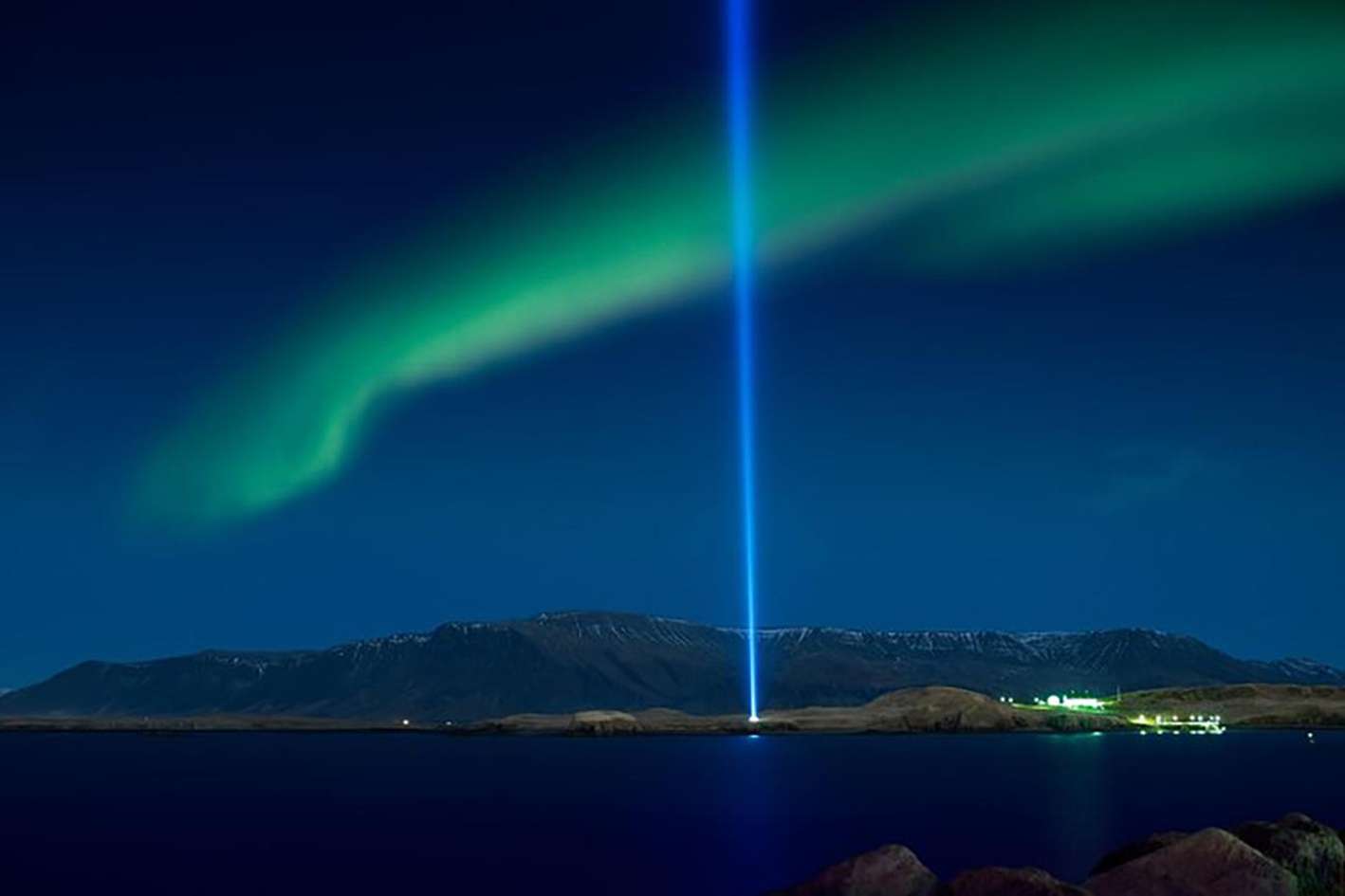
Northern Lights Cruise from Reykjavik - Boat or Yacht Trips
Skip the coach depot and step straight onto a warm boat at the Old Harbor. Choose your date and book ahead, and you'll be out on Faxaflói Bay in fifteen minutes, watching the city lights fade behind you while thermal overalls, a heated lounge and a free retry ticket keep the night easy. Pick your yacht and cruise into open water.
4.2★average rating2,096traveler reviews100%free cancellation25countries travelers came from
Cruise out from Reykjavik - start here
sail the first night, retries are free
Four northern lights cruises leave from Reykjavik's Old Harbor onto Faxaflói Bay, and the choice comes down to how you like to spend two hours at sea. A bigger sightseeing boat gives you decks, a bar and company. A motor yacht keeps things quiet and close to the water.
importantHarbour rules stop all cruises from Reykjavik Old Harbor when sustained winds exceed 14 m/s or gusts exceed 20 m/s, and captains cancel sailings on rough seas or heavy cloud cover.
Check the forecast the afternoon of your cruise, since captains decide late in the day. If your sailing is cancelled, you can reschedule for another date or receive a full refund.
The four northern lights cruise options
small yachts sell out early, book the night before
Lowest ticket cost
2.5 hours·English
4.0(113)
Reykjavík: Northern Lights & City Cruise
At 2.5 hours with warm overalls, blankets and a heated indoor saloon included, this cruise keeps things simple and easy on the budget.
Free cancellationWarm overalls, raincoats and blankets on boardNaturalist guide to enhance your experience
What a northern lights cruise on the yacht is like
free reschedule if no lights show
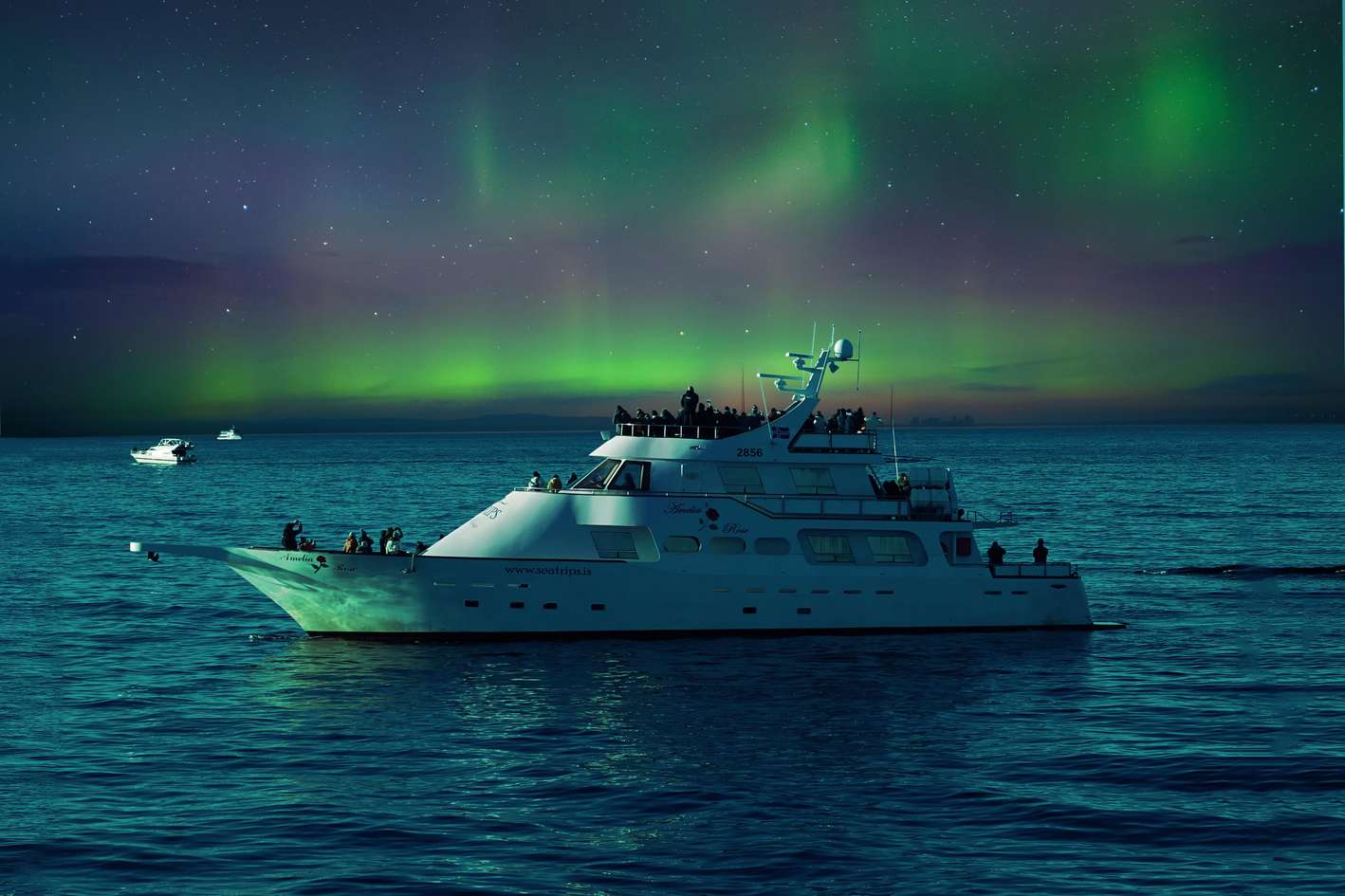
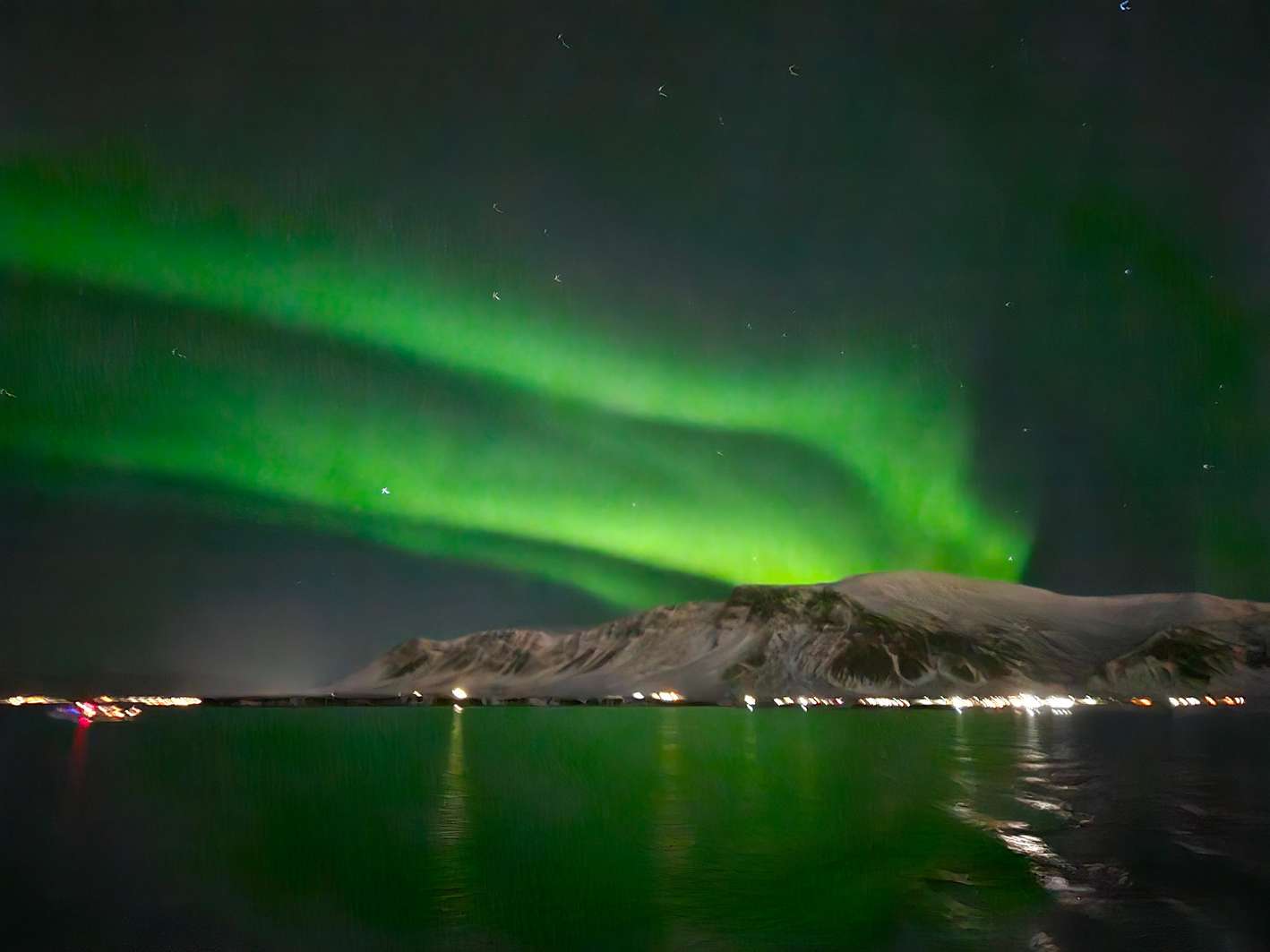
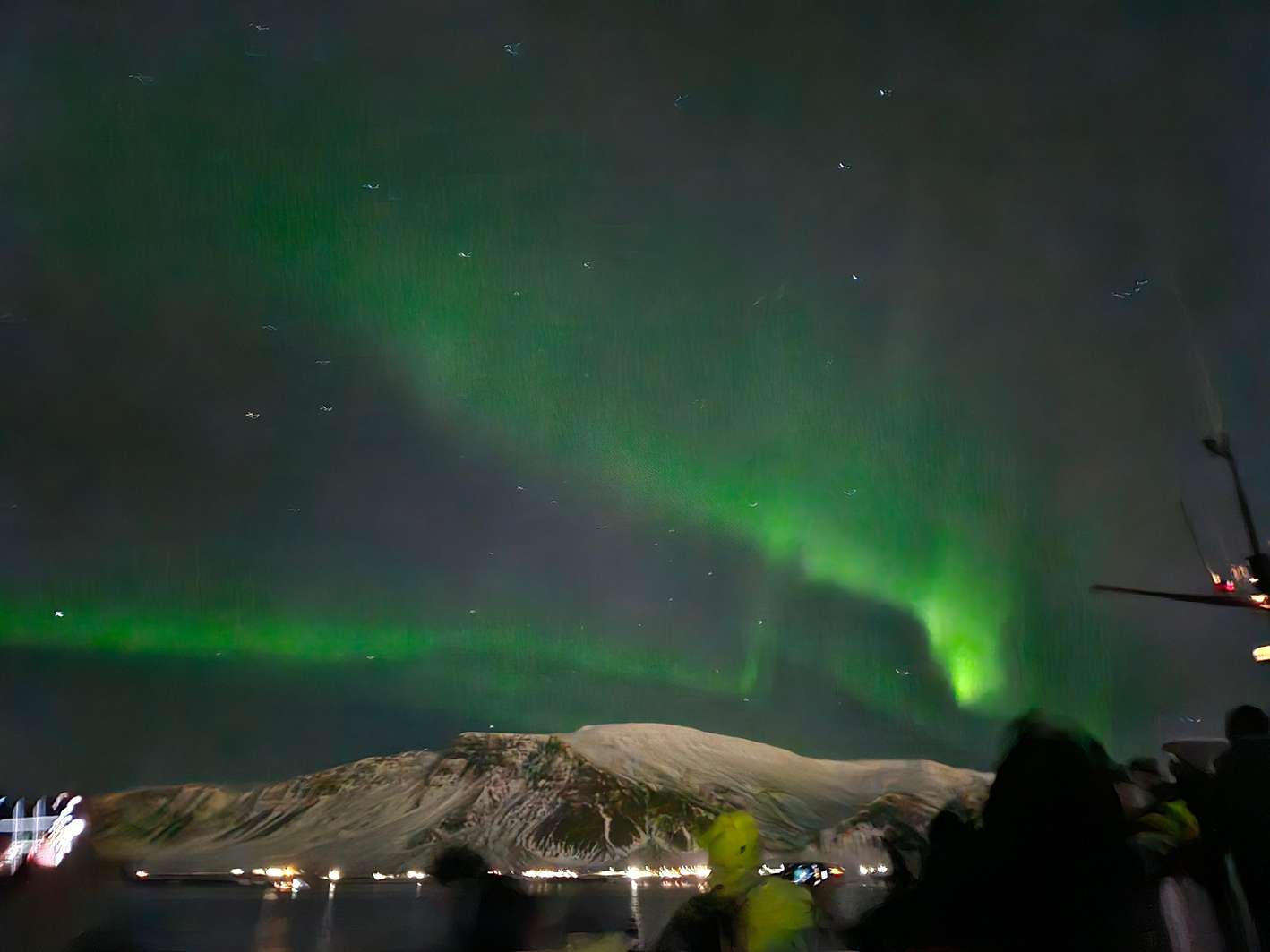
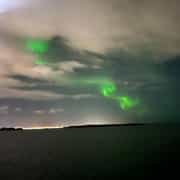
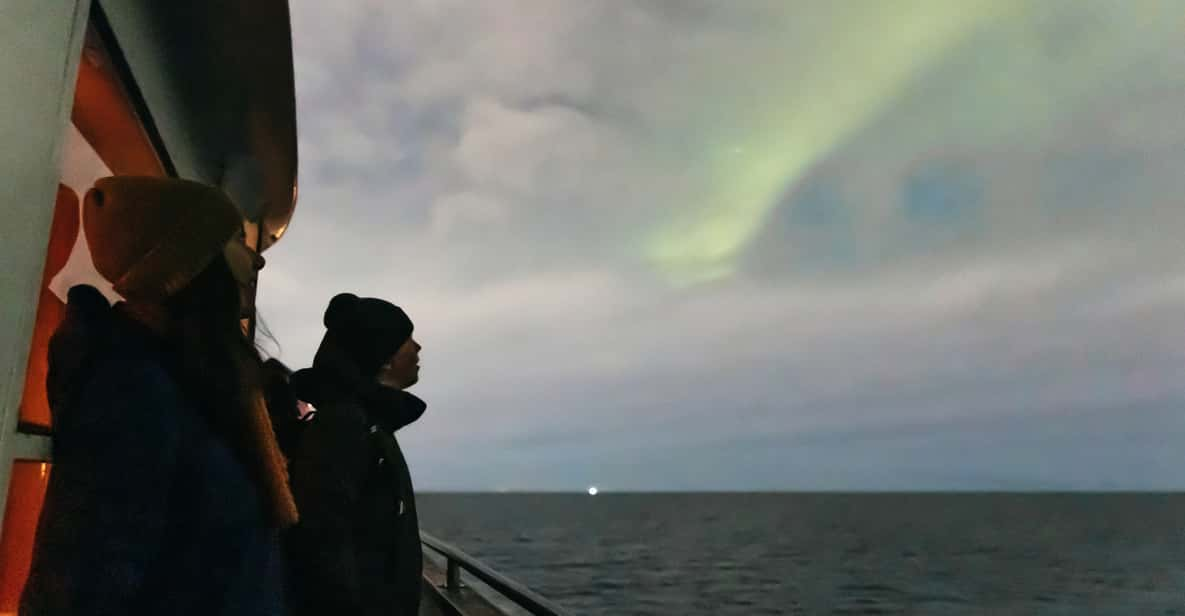
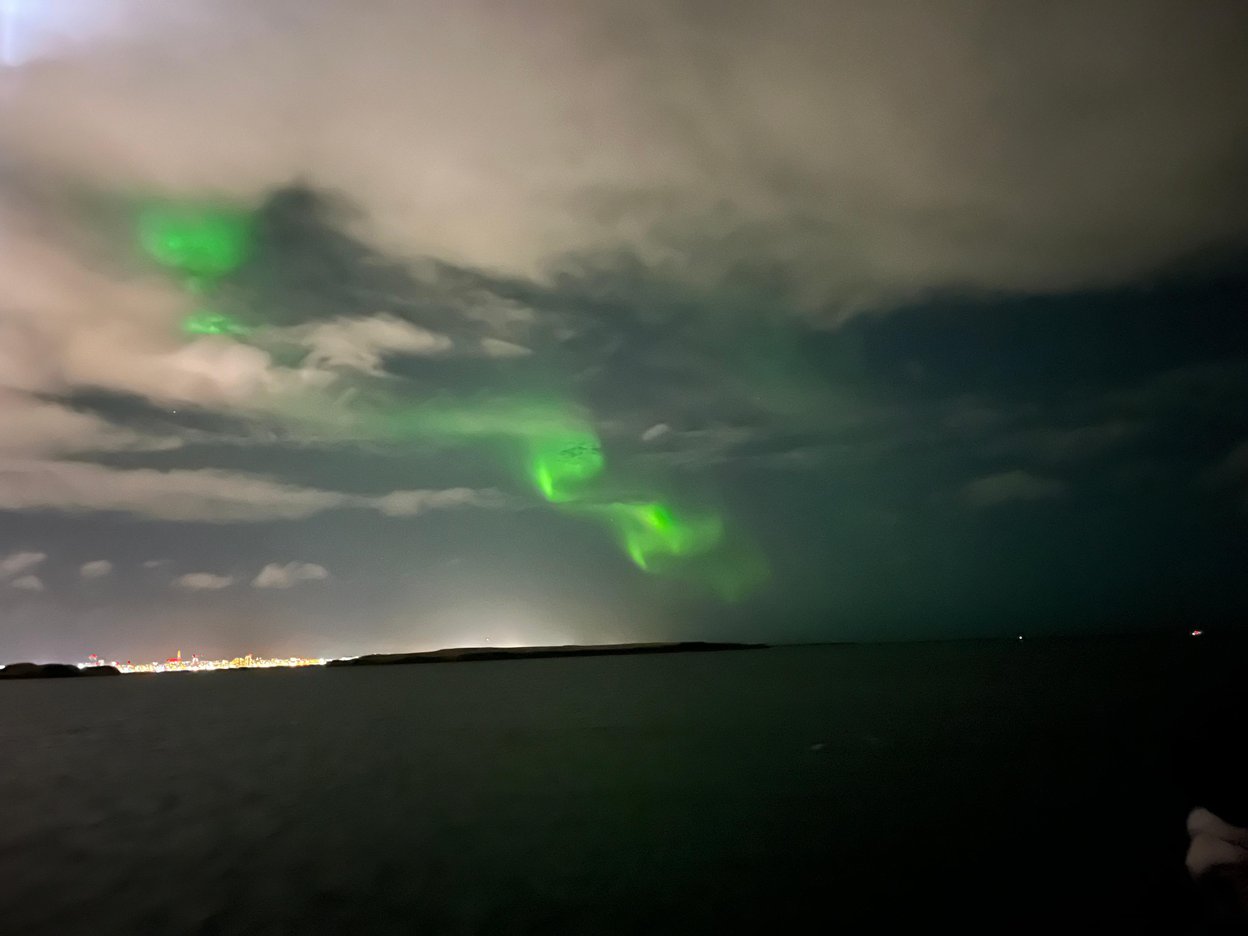
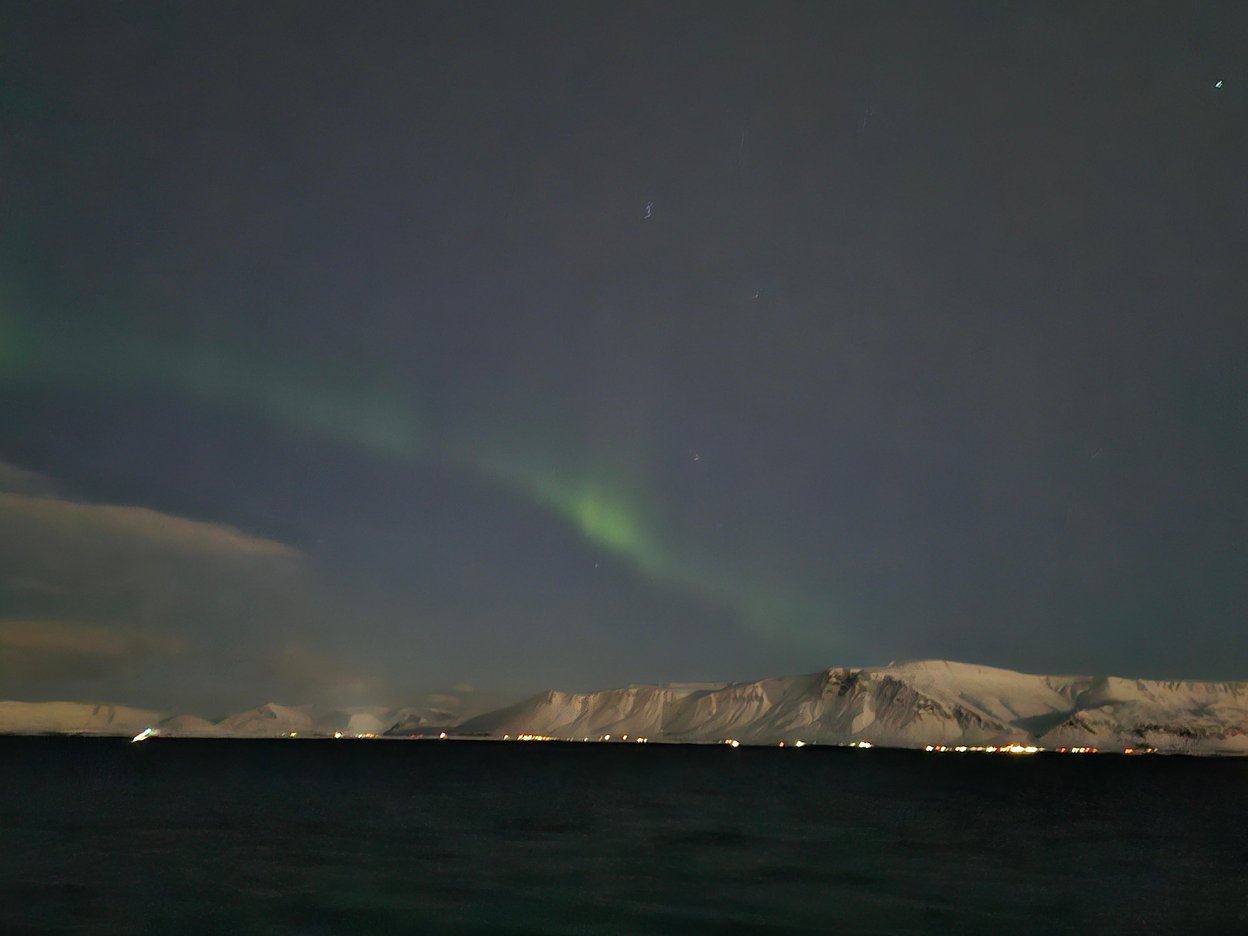
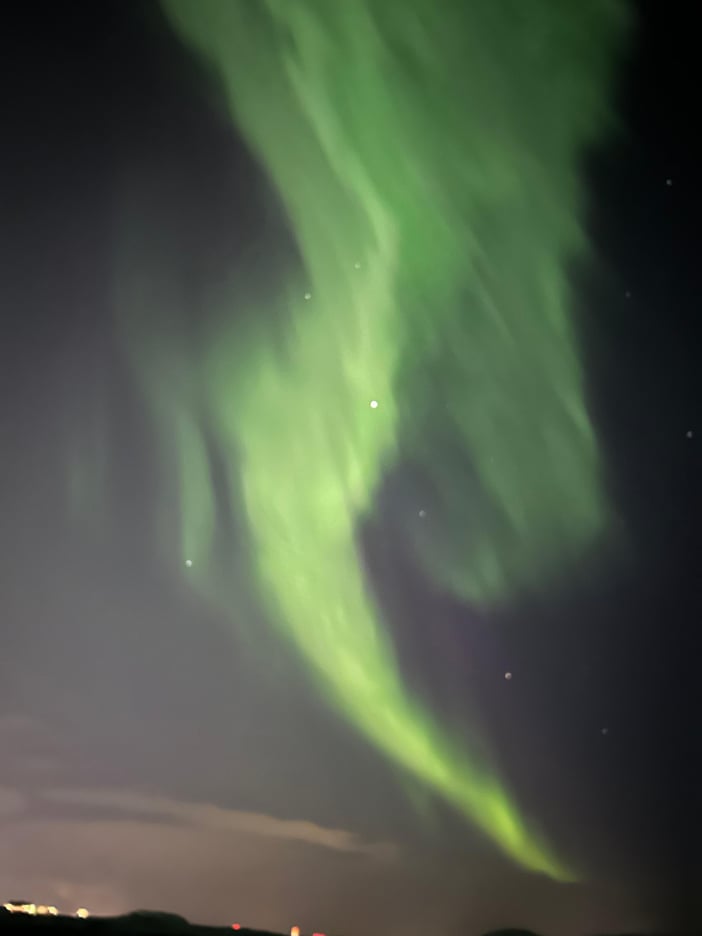
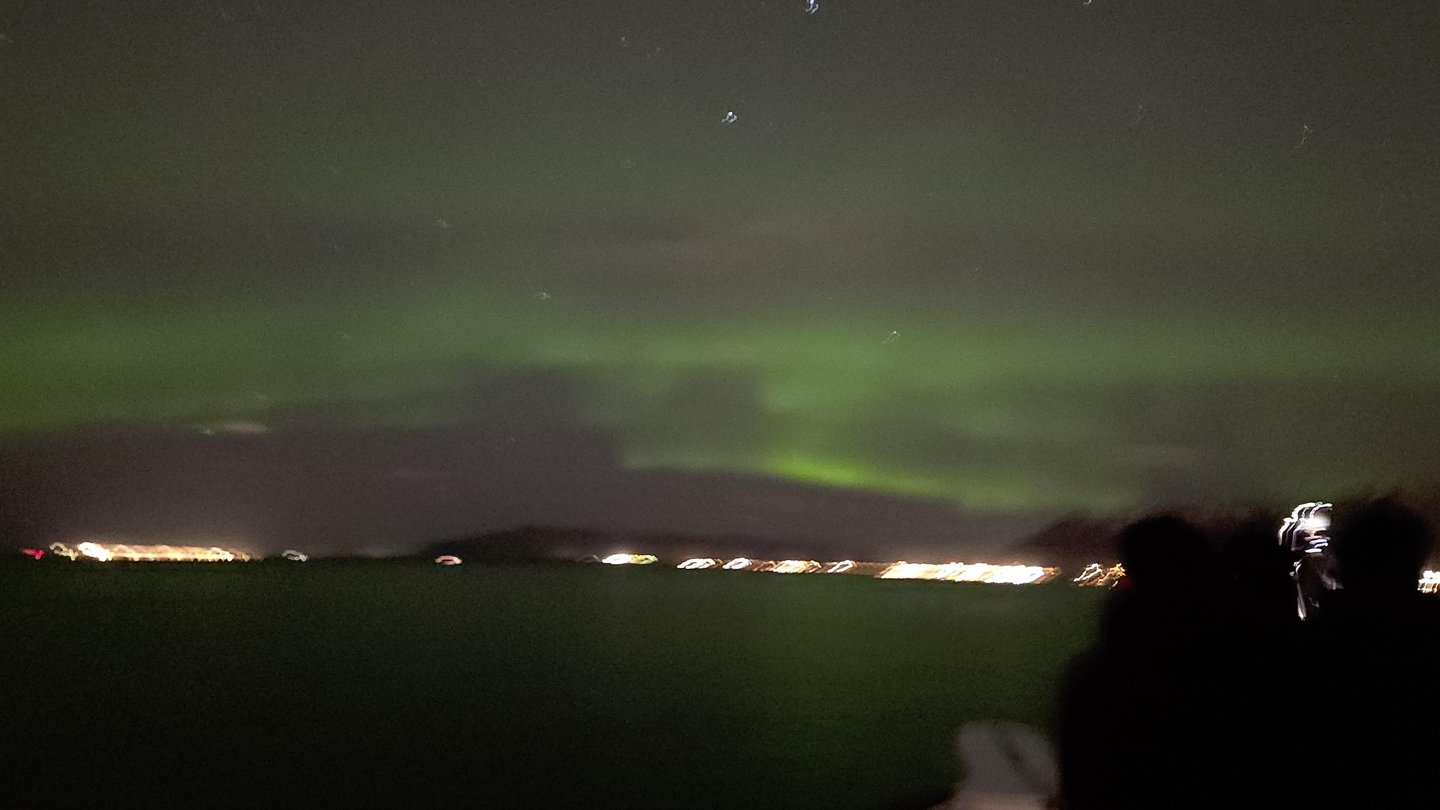
A green flare over open water, with nothing between you and the horizon: that is the sell of a northern lights cruise from Reykjavik.
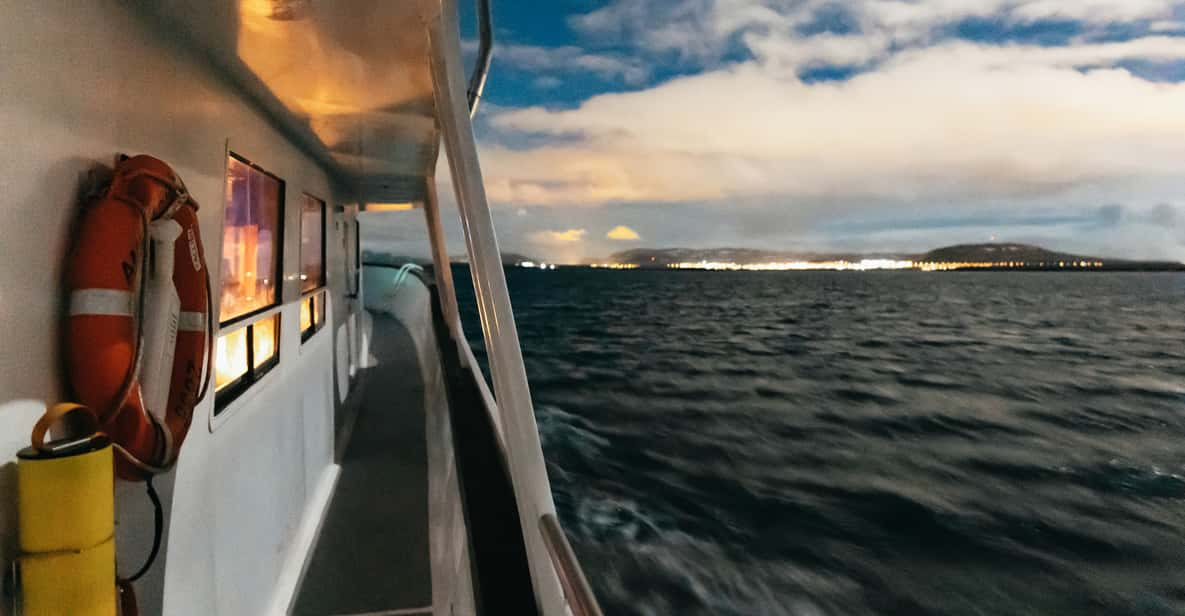
The yacht leaves the Old Harbour and spends its first 15 to 20 minutes cutting past the small islands of Faxaflói Bay, sailing about 4 nautical miles offshore until Reykjavik's glow falls behind and the whole sky dome opens up in every direction.
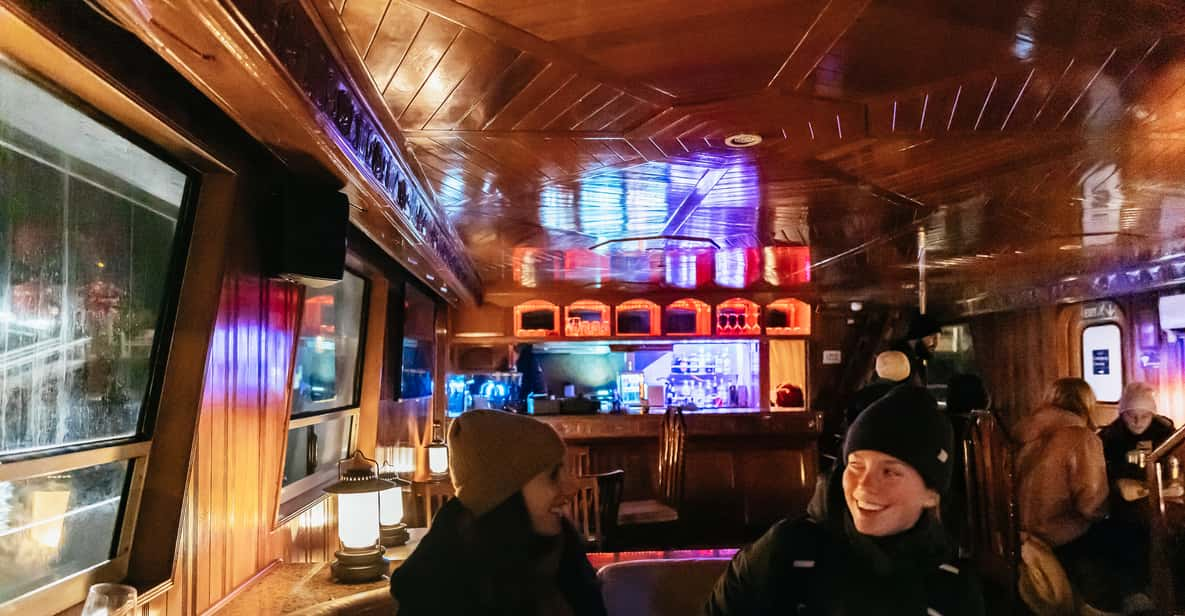
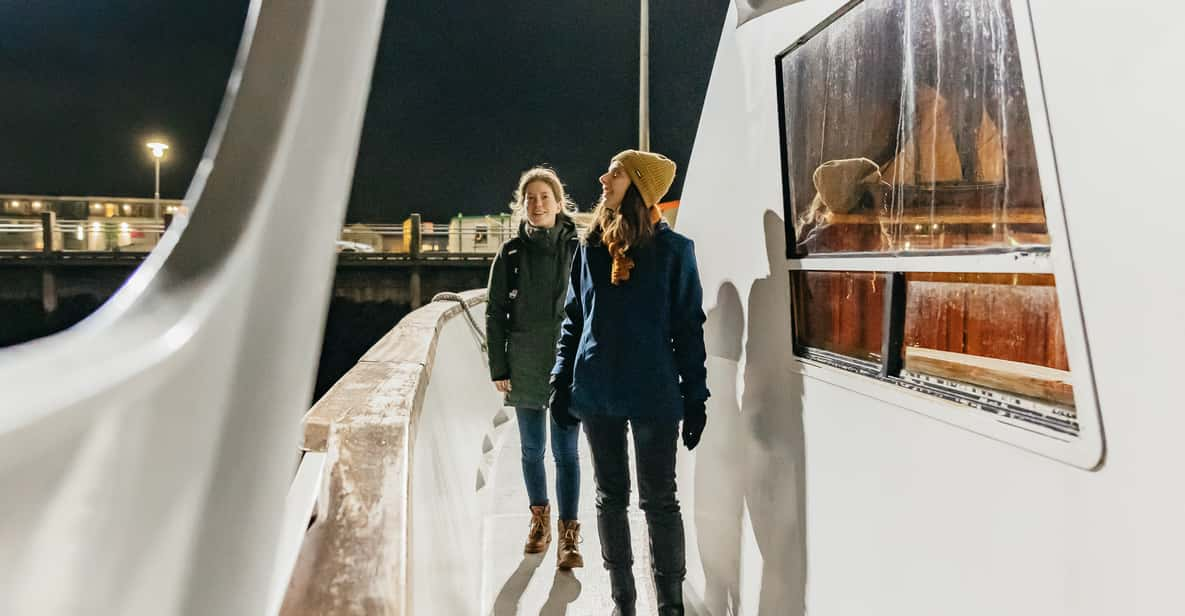
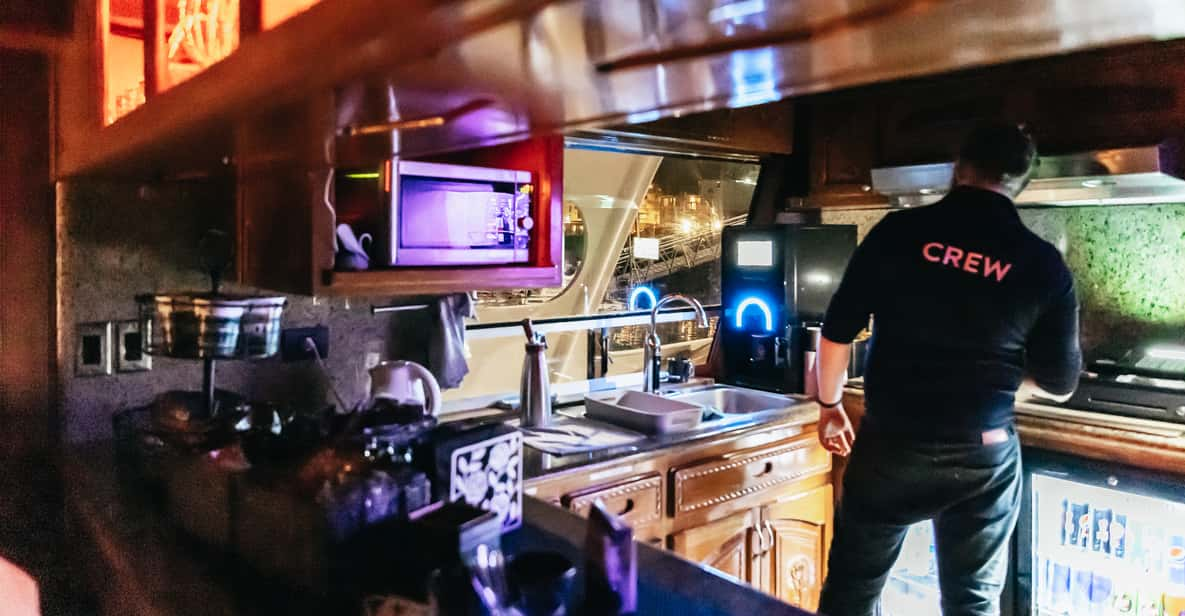
You are not stuck on a cold rail to wait. Warm blankets come with the ticket, and a bar and lounge inside lets you swap the deck for heated windows whenever the wind bites.
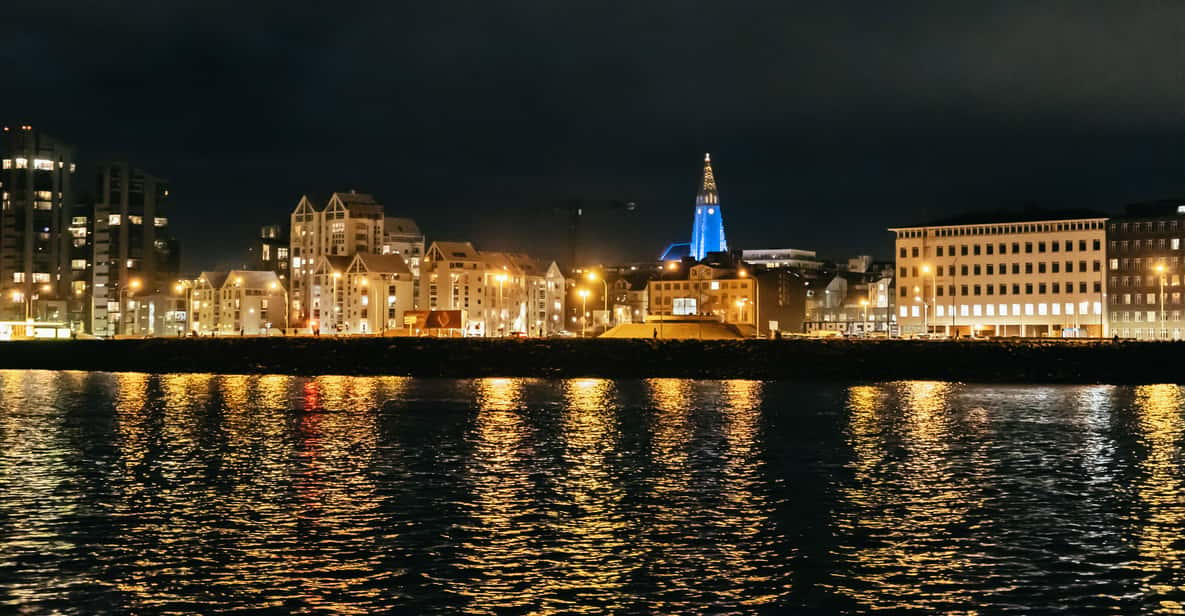
The rest of the evening belongs to the sky, and the city lit up on the shore as you make your way back.
Stop 1Out past the islands· about 20 minThe yacht weaves among Akurey, Lundey and Engey, then heads into the bay away from the city lights.Stop 2Dark water, full sky· about 20 minRoughly 4 nautical miles offshore, the city glow drops away and every passenger gets a clear 360-degree view of the sky.Stop 3The watch from three decks· about 50 minYou pick a spot on the triple-deck panoramic area to watch for green, pink and white light, blankets in hand.Stop 4Warmth indoors· about 20 minWhen the deck wind wins, the inside bar and lounge keeps you in the hunt with drinks to buy and Wi-Fi on board.Stop 5City lights on the way home· about 10 minThe cruise closes with Reykjavik's coastline lit up across the water before you step back onto the pier.
Most reviewers praise the guides and crew, who spot the lights first, share stories, and set up phone cameras.
Best surprise
Many did not expect to stay so warm, thanks to borrowed overalls, blankets, and a heated cabin below deck.
Most common wish
Several wished for clearer check-in directions at the harbor, after waiting unsure of where to board.
How to book your Reykjavik cruise beneath the northern lights
free retry ticket if the lights stay away
01
Pick your first free night
Book the cruise for the first evening of your stay. If rough seas or cloud cover cancel it, or the lights stay away, you get a free retry ticket for another night, so the rest of your trip is your backup.
Pro tipWinter cruises leave the Old Harbor at 9 pm from October to mid-March, and at 10 pm in September and from March 15 to April 15, so plan dinner around that.
RecommendedCancel up to 24 hours in advance for a full refund, so book the date early and adjust later if plans shift.
02
Choose meeting point or pickup
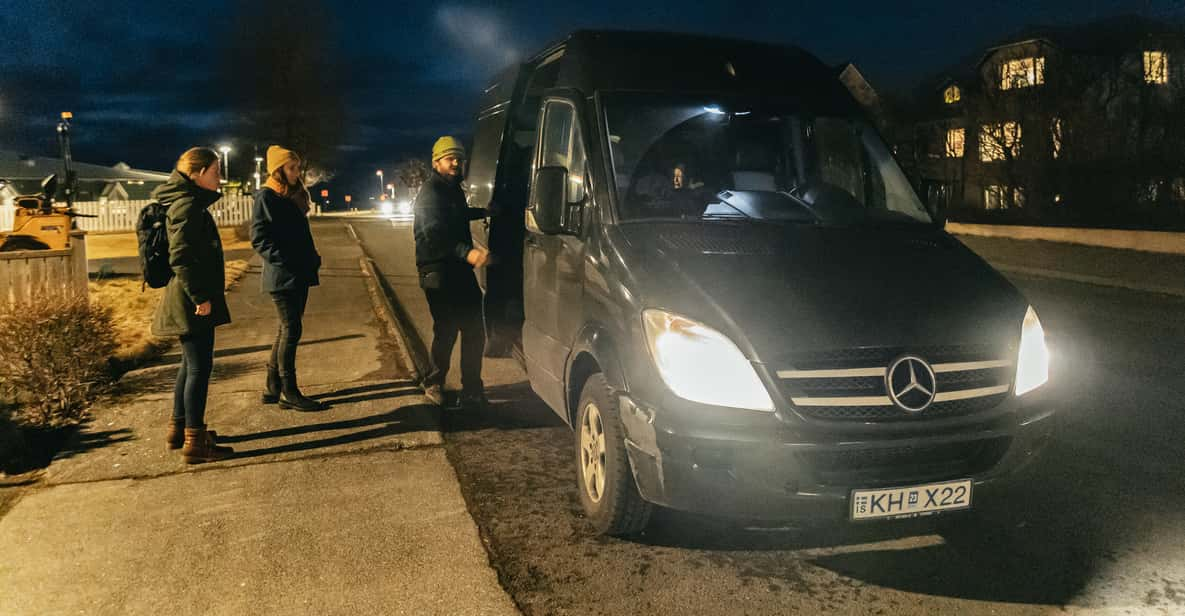
Every cruise offers two options: walk to the Old Harbor yourself, or add hotel pickup and drop-off. The meeting point option suits you if your hotel sits near the waterfront; pickup suits everywhere else.
Common mistakeFirst-timers often add pickup without checking the walk. Central downtown hotels reach the Old Harbor in 10 to 15 minutes, about 5 minutes more on icy sidewalks.
RecommendedIf you walk, allow extra time in winter, since packed snow slows the coastal path.
03
Confirm and save the voucher
After payment, the confirmation and voucher arrive by email. Keep it on your phone; a printed copy works too, but a digital device is accepted when boarding.
ImportantCheck the cancellation email is not sitting in spam. Operators send updates about sea conditions and departures by email, and decisions on whether a cruise runs are made late in the afternoon.
Pro tipSave the confirmation offline before you leave the hotel, since harbor Wi-Fi can be busy at boarding time.
04
Check in at the Old Harbor
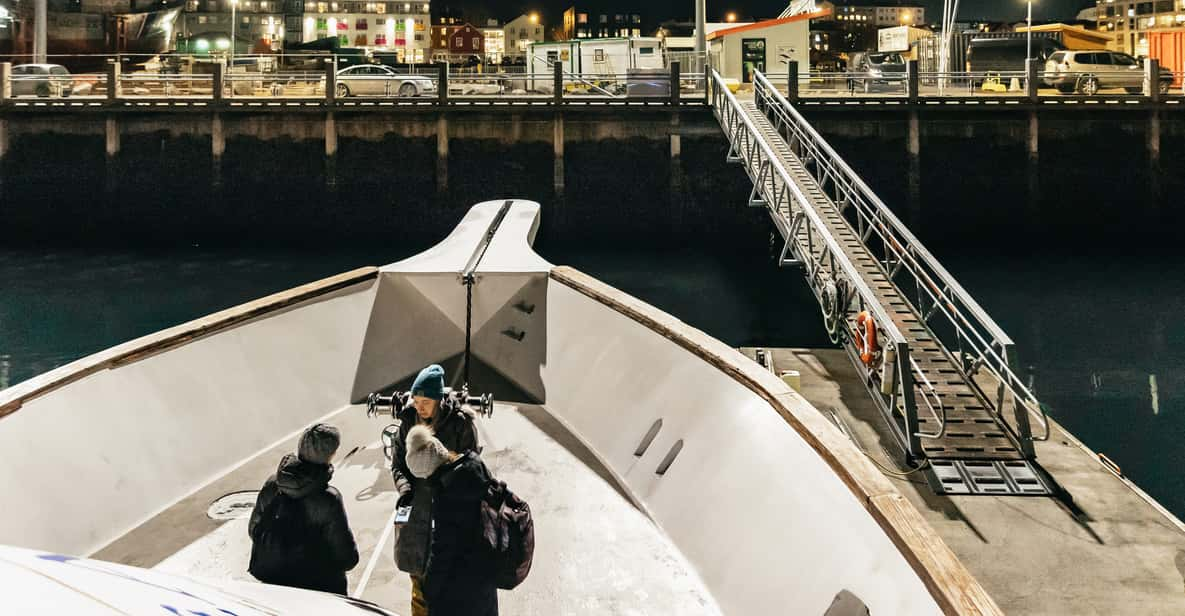
Arrive at the Old Harbour and exchange your voucher for a boarding ticket at the ticket office by the harbor. After check-in, wait inside the warm indoor lounge until the crew calls you aboard.
Pro tipCheck in early and use the lounge instead of standing outside; thermal overalls are handed out on board in adult and children's sizes.
Common mistakeSome travelers queue on the cold pier before boarding starts. The ticket office and lounge handle everything indoors.
05
Dress in layers for the deck
Wear proper warm layers underneath the overalls: a wool or synthetic base layer, a fleece mid-layer, warm trousers, and insulated boots with wool socks, plus a hat and gloves. Then step out and watch for the lights.
ImportantGuides can refuse boarding if a guest arrives without suitable winter outerwear, since standing still on an open deck in freezing wind is a safety matter.
RecommendedIf you are prone to seasickness, take motion sickness tablets one to two hours before departure; some crews keep free tablets on board as well.
What to know before you book your cruise - Reykjavik northern lights, costs and conditions
boats sail 15-20 min out to reach dark water
Can stop the dayGood to knowGood news
01
ChoosingWhat it is, who it suits, when to go
5
Timing
Cruises depart at 9 pm in the core winter season, from October to mid-March, and at 10 pm in September and from mid-March to April 15. You are out on the water for 2 to 2.5 hours and back at the pier between 11 pm and 1 am.
No lights
If the boat sails and the aurora never shows, you get a free ticket or reschedule for another night, so book the cruise for your first evening in Reykjavik. That leaves the rest of your stay for a retry.
On board
Every vessel has a heated indoor lounge with panoramic windows, so you can step inside when the wind bites and return to the deck when the crew calls out a sighting. Hot drinks and snacks are sold at the onboard bar, and drinks are not included in the ticket.
MobilityCan stop the day
These boats have high door thresholds, steep stairs between decks and limited access to cabins and restrooms, so they are generally not well suited for severe mobility impairments. If this affects you, contact the operator before booking to confirm the vessel works for you.
Season
Cruises run from late August through April 15. After that, the nights stay too bright for the season to continue, and departures stop until darkness returns in late August.
02
BookingHow far ahead, and what happens if plans change
2
Cancellation
Every cruise here can be canceled up to 24 hours ahead for a full refund. If rough seas or total cloud cover call the sailing off, you choose another night or get your money back. The operator can also help move you to a land tour instead.
Group size
The motor yacht cruises carry a smaller crowd, up to 35 or 95 passengers depending on the vessel, while the sightseeing boat takes more. Small yachts sell out early, so book them in advance; the big boats can usually be booked the same day.
03
Before you goPapers, health, what to bring
2
Seasickness
Winter swells on Faxaflói Bay can be big, and calm seas are rare between December and February. Captains stay near sheltered waters and islands, and free seasickness tablets are on board. Take yours 1 to 2 hours before sailing if you are prone to motion sickness.
Warmth
One cruise lends warm overalls, raincoats and blankets to everyone, and the yacht tour hands out blankets. Underneath, wear your own wool or synthetic base layers, a fleece, a windproof jacket and sturdy boots with a hat and gloves.
04
On the dayWhere to be, when, and how you get there
2
Meeting point
All four cruises leave from Reykjavik Old Harbor. You check in at the ticket office by the harbor and swap your voucher for a boarding pass, and you can show it on your phone. A printed copy works too.
Pickup
Three of the four cruises can collect you from your hotel in Reykjavik for a small extra charge, so you can skip the walk to the harbor if you prefer. The yacht tour bundles pickup into its hotel option.
05
During the tourWhat is expected of you
1
Photos
A moving deck blurs long exposures, so use a fast lens and a high ISO to keep exposures around one second. Switch to manual focus on a distant star, since autofocus struggles with auroras in the dark.
Northern Lights boat and yacht cruises from Reykjavik - deck, dock and booking guide
cancellation email lands by 6:30 pm
A 4-nautical-mile steam out of the Old Harbour leaves the city glow behind, and the sky opens in every direction. Pick your vessel, time your walk to the pier, and know what happens when wind or clouds say no.
Reykjavik
If you only remember three things
1
Book for the first night of your stay: a cancelled or empty-handed cruise leaves the rest of the trip for a free retry.
2
Read the cloud forecast on the Icelandic Met Office site in the late afternoon; prioritize cloud cover over the Kp number.
3
Small yachts sell out early, so book the day before; large sightseeing boats can usually be booked on departure day after the forecast.
When does the cruise season run in Reykjavik?
Boat season opens in late August, with departures from 25 August through 30 September, and closes on 15 April in spring. After that date the long Icelandic daylight leaves no true night to sail into, and the harbour goes quiet until autumn.
Midwinter, from November to March, brings the deepest darkness and roughly 13 to 20 clear dark nights within about 75 km of the city each month. September and October sit in the shoulder: fewer dark hours, smaller crowds, and departures an hour later, because true night arrives late.
The two night counts tell different stories, and both are right.
The 13 to 20 figure counts clear dark nights anywhere within about 75 km across the whole midwinter; the city's own count runs lower, 9.3 clear dark nights in January in Reykjavik and 14 within about 75 km, because cloud often spares the wider region while covering the city.
January, February and November are the busiest months. May to July have no fully dark hours at all, so no cruise can chase the aurora then.
Before the widget below, one thing to watch: April is the month where the season dies, and the numbers show exactly why.
April daylight and late-season cruise departure
15h 10m of daylight
1
00061218245:54 am sunrise9:03 pm sunset
110 pm Cruise departure
DarkDaylightSunrise and sunset, averaged for Apr
Read April against midwinter and the trade is plain: warmer temperatures and far smaller crowds, but full darkness shrinks to under 4 hours a night. If your trip falls in April, book the first clear night you get.
Book early in your stay no matter which month you pick. A cruise that cancels or sails home empty-handed still leaves the rest of your trip for a free retry.
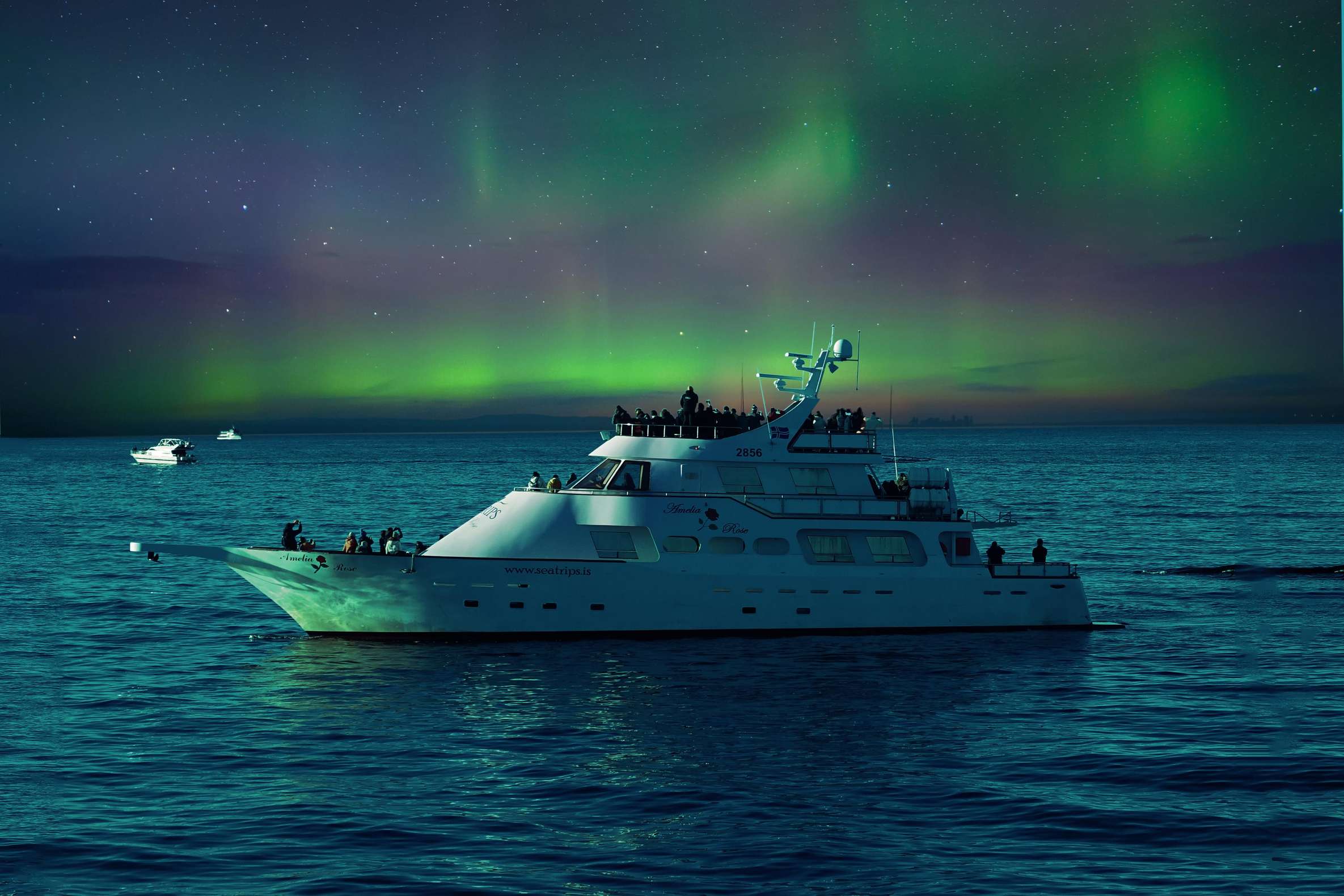
Four cruises leave the Old Harbour onto Faxaflói Bay, and they differ more in deck and duration than in the aurora itself. The yacht cruise runs 2 hours, with three panoramic decks, a bar and lounge, warm blankets, and a hotel pickup option.
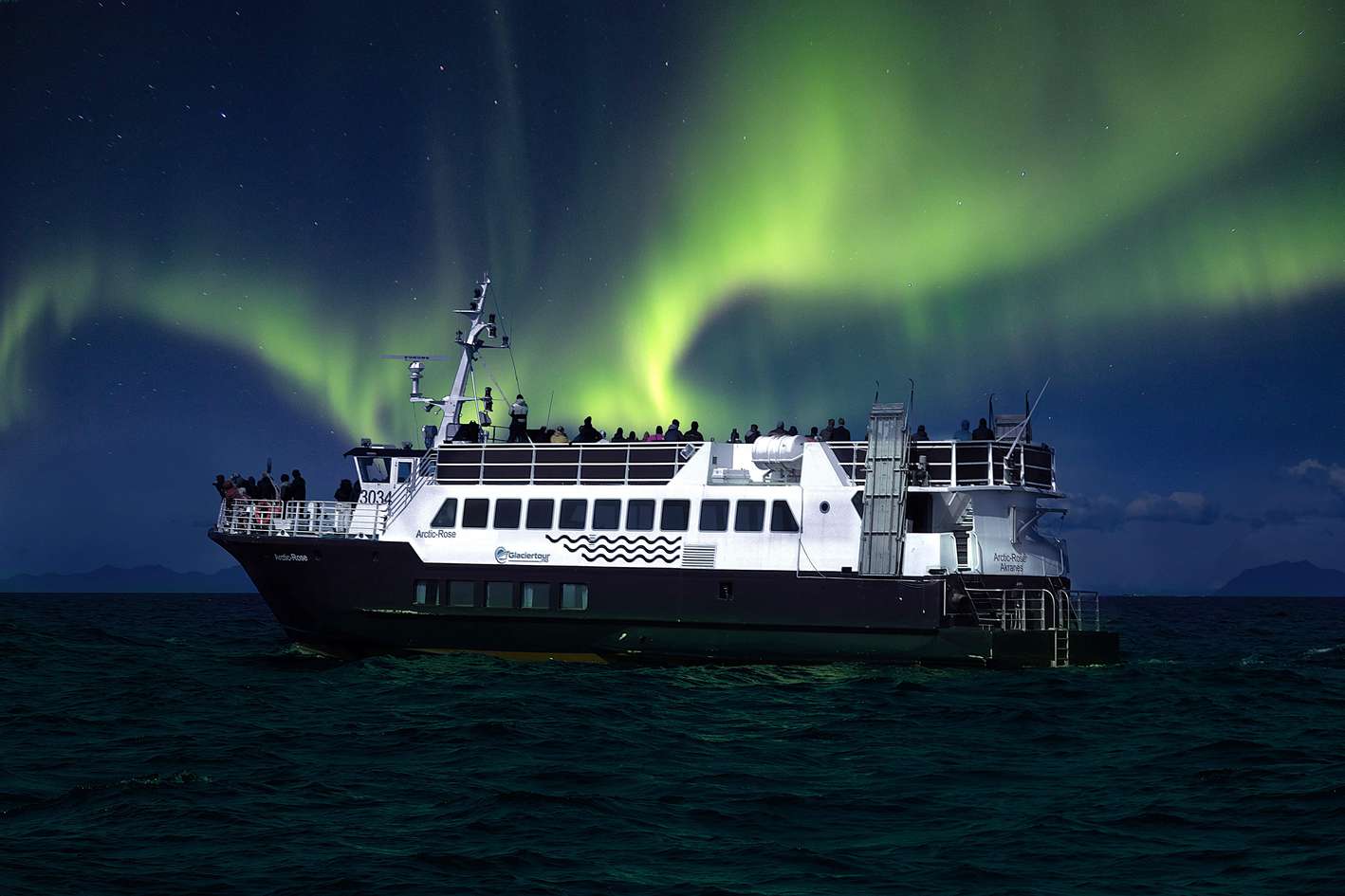
The sightseeing cruise on a larger boat runs 2 to 3 hours. Two run about two and a half hours: a lights-and-city cruise that adds Reykjavik's lit-up shoreline from the water, and a dark-sky motor yacht cruise built for reaching darker water.
All four share the same core. Each sails out past the city glow, watches the sky, and warms up inside between deck runs, because downtown streetlights wash out fainter displays.
The next widget carries the two numbers that explain why the boats bother leaving at all.
Sailing into Faxaflói Bay to escape city lights
4 nautical milesdistance offshore into the bay
15-20 mincruising time to dark skies
Twenty minutes of steaming changes what you can see. Strong displays show right above downtown on clear, active nights, and you can spot them from the Sun Voyager on the waterfront without a ticket. For anything moderate or faint, the open bay is where the sky goes dark in every direction.
Tour for this
From Reykjavik: Northern Lights Sightseeing Cruise4.3★ (461) · 2 hours · Hotel pickup · Free cancellation
Match the vessel to the evening you want. The big sightseeing boat carries the most people, keeps the ticket at the low end of the three, and can usually be booked on the day of departure once the evening cloud forecast is out.
The lights-and-city cruise adds Reykjavik's illuminated shoreline and includes overalls, raincoats, blankets and a naturalist guide, with a sighting guarantee. The two yacht trips trade size for quiet: a motor yacht with three decks and a bar lounge, and a dark-sky yacht aimed at the darkest water.
Small vessels sell out first. Book the yacht a day or two ahead; waiting until departure afternoon risks finding it completely gone. Large boats hold places into the day of sailing.
Seasickness is the other filter. In December through February, calm seas with waves under 1.5 metres occur on only 6 to 9 percent of days, and November about 20 percent.
If your stomach has opinions, pick a cruise that stays near sheltered waters, take the free tablets an hour or two before sailing, before the swell builds, and accept that a rough swell may keep you in the heated cabin while others watch from the deck.
Big sightseeing boat or luxury yacht cruise - how they compare
Price, deck space, crowd size and duration are what actually separate the choices, so put the three main cruises next to each other.
"Three cruises side by side"
Ticket price
The lights-and-city cruise costs the least; the small motor yacht costs the most
Vessel size
Large sightseeing boat, mid-size city cruise boat, small motor yacht with three decks
Heated indoor lounge
All three have one; the yacht's doubles as a bar and lounge
Total duration
2 to 3 hours on the sightseeing boat, 2.5 hours on the city cruise, 2 hours on the yacht
Ticket price
Vessel size
Large sightseeing boat, mid-size city cruise boat, small motor yacht with three decks
Heated indoor lounge
All three have one; the yacht's doubles as a bar and lounge
Total duration
2 to 3 hours on the sightseeing boat, 2.5 hours on the city cruise, 2 hours on the yacht
The lights-and-city cruise costs the least; the small motor yacht costs the most
The yacht is the premium pick: fewer passengers, three decks, blankets, and hotel pickup as a booking option.
The city cruise is the value pick, with overalls, raincoats, blankets and a naturalist guide included, plus a retry if the lights stay away. The big sightseeing boat is the flexible pick, with places usually still open on the day itself.
The booking rule runs the same way on every choice. Book the yacht the day before at the latest. The large boats can wait for the evening cloud forecast and still take you that night.
How do you get to Reykjavik Old Harbor for your 9 pm cruise?
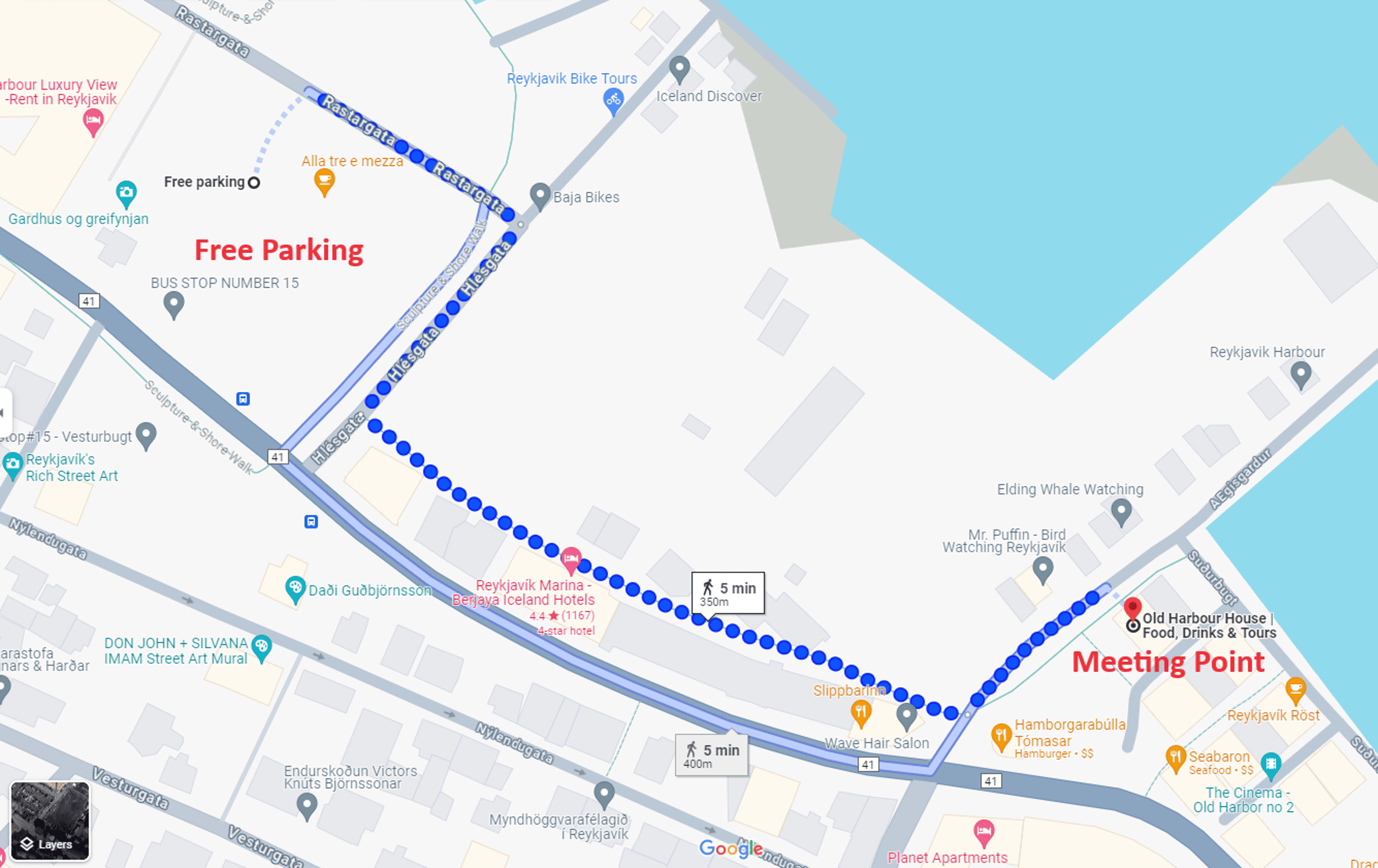
The pier sits a flat walk from most downtown hotels, and the timing matters more than the route. Central hotels near Kvosin and City Hall put you about a 17-minute walk from the harbour; from Hlemmur and Laugavegur it is about 19 minutes.
In winter, packed snow and icy sidewalks add roughly 5 minutes or more, so leave earlier than the summer map suggests.
The widget below puts the two walking routes and the bus fallback side by side, so you can see at a glance which one fits your hotel.
Getting to Reykjavik Old Harbour from downtown hotels
Flat walk across downtown, allow for iceDirections →
19 minDirect walk
Strætó bus
Direct lines run towards Grandi harbourDirections →
12 minRoute 3 or 14
For most central accommodations, walking is the simpler choice over navigating bus routes. Check in at the ticket office by the Old Harbour, where vouchers are exchanged for boarding tickets, then wait in the warm indoor lounge until the crew calls you aboard. Aim to arrive with half an hour to spare.
What happens on the night of your cruise - overalls, hot drinks, your stomach
Midwinter sailings leave at 9 pm, from October to mid-March. In September and from 15 March to 15 April, departure shifts to 10 pm, because true night arrives late. Vessels stay out 1.5 to 3 hours, typically 2 to 2.5, and return between 11 pm and 1 am depending on departure time and viewing conditions.
Free thermal overalls come on board in adult and children's sizes, to wear over your own layers. Dress in merino wool or synthetic base layers, a fleece or thick wool sweater, warm trousers, sturdy insulated boots with wool socks, and a hat, scarf and gloves.
Underestimating the wind chill on open water leaves people cold fast; the sea breeze feels sharper than any land outing.
The checklist below turns that into a packing list you can work through the night before.
Clothing and thermal gear for harbor boat tours
Thermal overallsProvided on board in adult and child sizes to slip over your clothes for standing out on the open deck.
Thermal base layersLong-sleeved tops and thermal bottoms in merino wool or synthetics to wick moisture away from your skin.
Fleece or wool sweaterA warm mid-layer such as a fleece jumper or thick Icelandic wool sweater to trap body heat.
Weatherproof jacketA windproof and water-resistant outer jacket worn over sweaters before stepping into loaner overalls.
Warm outdoor trousersSki pants or sturdy wind-resistant trousers worn over thermal leggings.
Sturdy insulated bootsThick-soled walking or winter boots with wool socks to withstand cold, damp deck surfaces.
Warm hat, scarf, and glovesEssential protection for extremities exposed to chilly ocean breezes during night sailings.
Work down the list and you will be warm for a full three hours on deck. Between deck runs, the heated inside area has panoramic windows, with hot drinks and bar drinks paid at the counter. Take the free seasickness tablets an hour or two before sailing, before the swell builds.
Harbour authority rules prohibit cruise vessels sailing when sustained winds exceed 14 m/s or gusts exceed 20 m/s. Beyond those caps, captains judge each afternoon: no fixed wave-height threshold is published, and departures are cancelled when wave height passes safe limits, gale warnings are issued, or the sea simply looks wrong.
The decision lands late afternoon. Some operators decide by 6:15 pm, others by 6:30 pm, and when the cloud forecast is uncertain one may hold out until 5 or 6 pm. A cancellation email reaches you on the day of the tour.
A cancelled sailing costs you nothing. You choose another date, take a full refund, or often switch to a land experience with a partner, such as ATV tours, horse riding or museum tickets. Refunds are requested by email.
The month table below shows which weeks give you calm water and which give you gales, so you can match your booking to the sea as well as the sky.
Wind, waves, and tour demand by month in Faxaflói Bay
January: 5 out of 5 for how busy it gets. Peak tour demand brings the year's roughest seas with 20 windy days and waves reaching 3.3 meters.
HighestNov to Mar
In betweenOct
LowestApr to Sep
Darker: a higher how busy it gets score, out of 5
Tap a month to read it.
July: calm sea on 59% of days. Northern lights boat tours do not run in July due to continuous daylight.
HighestJun to Aug51 to 59% of days
In betweenApr to May, Sep to Oct27 to 39% of days
LowestNov to Mar6 to 20% of days
Darker months: higher, from 6 to 59% of days
Tap a month to read it.
February: waves up to 4.4 m on an average day. Visitor numbers remain at peak levels while seas stay very rough with wave heights averaging 4.4 meters.
HighestFeb, Dec3.5 to 4.4 m
In betweenJan, Mar, May, Nov2.5 to 3.3 m
LowestApr, Jun to Oct1.5 to 2.2 m
Darker months: higher, from 1.5 to 4.4 m
Tap a month to read it.
January: 20.2 windy days. Peak tour demand brings the year's roughest seas with 20 windy days and waves reaching 3.3 meters.
HighestNov to Mar17.4 to 20.2 days
In betweenApr, Sep to Oct11.8 to 14.6 days
LowestMay to Aug4.6 to 9 days
Darker months: higher, from 4.6 to 20.2 days
Tap a month to read it.
Read that table before picking a month. December and January pair deep darkness with the roughest sea; April trades some dark hours for far calmer water.
How do you photograph the aurora from a moving deck?
Long exposures do not survive a boat. Engine vibration and ocean swell blur anything slow, so shoot short and bright instead: a fast lens, high ISO, and exposures kept around one second.
Autofocus struggles in the dark, so take manual control. Focus on a distant star or bright object, using the camera screen's magnification to confirm.
Phones do more than people expect. Night mode detects faint auroral colours the naked eye reads as a grey haze. Switch the flash off, use the primary 1x lens, and steady the phone on a solid surface or brace; a self-timer or remote shutter removes the shake of tapping.
On an iPhone, tap the moon icon in Night Mode and slide exposure to the maximum available setting. If the lights move fast, shorten the exposure to keep their structure sharp.
Cold is the silent killer. Below freezing, phone batteries lose charge quickly or shut off without warning. A camera that dies may simply need warming; hold the battery in your hands or pocket and it often comes back.
Never recharge a frozen battery, since that damages the cell. Keep spares in an inside pocket close to body heat.
"What first-timers don't know"
The camera sees it first
Sensors register faint green and pink long before your eyes can separate the colours from a grey haze
Tripods lose on a boat
Engine vibration and ocean swell blur long exposures, so keep exposures short instead
What else is worth doing around the Old Harbor before your cruise?
The pier and the Grandi waterfront turn the hours around your sailing into a whole evening. Along the harbour, seafood spots like Kopar and Sægreifinn (The Sea Baron) sit within a few minutes of the gangway.
Old Harbour House serves food daily from 11 am to 9 pm, with happy hour from 5 pm to 7 pm, which fits neatly before a 9 pm departure. La Primavera at Harpa and The Roof at The Reykjavik EDITION add more sitting-down options.
Museums sit in the same 5- to 20-minute walk: the Reykjavík Maritime Museum, Aurora Reykjavík, the northern lights centre where you can learn the science before sailing, and the Reykjavík Art Museum Hafnarhús.
The list below gathers the closest sights and a few worth a short drive, so you can build the afternoon around your sailing time.
What if your cruise sails and the lights don't appear?
When the boat sails and the sky stays blank, no refund follows. Instead, Reykjavik boat and cruise tours hand you a free reschedule, a return ticket, or a retry tour on another night. A cancellation by the operator before you sail is the different case: that brings a full refund or a free reschedule.
Operators count sightings differently, and it matters for the guarantee. One operator counts a faint aurora visible to the naked eye as a sighting. Another does not count an aurora detectable only by camera and invisible to the naked eye toward its retry promise. Expect the camera-versus-eye question to decide a borderline night.
Book for the very first night of your stay. A cancelled or empty-handed evening then leaves every remaining night free for the retry. Travelers who do this turn a short winter trip into several chances, at the price of one ticket.
Would renting a car and chasing the lights beat a cruise?
A rental car gives you what no cruise can: control over the departure time and place, and the ability to hunt again on multiple nights without paying per trip.
For groups of three or more, or travelers who already have a car for daytime sightseeing, a self-drive chase costs less. Renting a car only for one evening hunt is poor value against a tour ticket.
The price is the road. Winter driving outside Reykjavik means sudden black ice, blowing snow, extreme crosswinds, and roads without guardrails. Soft snow shoulders on narrow rural roads can trap a car on hidden ice beneath the surface, and dark nights make safe pull-offs scarce.
Guides earn their ticket on exactly that. Drivers on organized hunts communicate in real time, track weather models, and find local cloud gaps a solo driver might miss.
Evening hunts typically run 30 to 80 kilometres from the city, a 30- to 60-minute drive toward the Reykjanes Peninsula, the Þingvellir area or Hvalfjörður. Lake Kleifarvatn, about 30 minutes out, has free pull-offs along Route 42, almost no buildings, and a full view of the sky dome.
Park only in designated pull-offs, keep the vehicle visible, and stay on approved tracks; driving off-road is against Icelandic law. If you are comfortable on a 4x4 in the dark, a self-drive night alongside your cruise makes a strong second attempt.
Driving yourself
Rent a car in ReykjavíkCompare cars from the rental companies in one search, then pick yours.
Absolutely fantastic cruise, we saw the northern lights and they were amazing. The guide was helpful spotting them and very knowledgeable. Comfortable boat, great crew. A wonderful way to end our holiday in Reykjavik.
A cruise from the Old Harbour is the easiest aurora night in Reykjavik: no winter driving, a heated cabin, free overalls on deck, and a free retry when the sky stays blank.
Pick the yacht for quiet and three decks, the city cruise for value and a naturalist guide, the big sightseeing boat for last-minute flexibility. Book the first night of your stay, take the seasickness tablets an hour or two before sailing, and dress for the wind.
Go ifGo if you want aurora reflections on the water and a warm cabin between deck runsGo if you would rather leave dark rural winter roads to a crew that tracks the forecastGo if you book the small yacht early enough to beat the sellout
Skip ifSkip if you are severely prone to motion sickness in winter swellsSkip if you want tripod long exposures; a moving deck will blur themSkip if a quiet campfire or land chase appeals to you more than a boat deck
Your Reykjavik cruise questions about the northern lights, answered
heated cabin when the wind bites
The practical questions people ask before booking an evening on the water.
Reykjavik2026
The city glow fades behind you in 20 minutes and the whole sky opens up. Bring your own hat and gloves, the overalls are free.
What time do northern lights cruises leave Reykjavik Old Harbor?
During the core winter season from October to mid-March, boats depart at 9 pm. In September and from March 15 to April 15, departures shift to 10 pm because true night arrives later.
Vessels stay out for 1.5 to 3 hours, usually 2 to 2.5, and return to the pier between 11 pm and 1 am.
How far out do boats sail to escape Reykjavik's city lights?
Cruises sail roughly 4 nautical miles, about 7.4 kilometres, offshore into Faxaflói Bay. That takes 15 to 20 minutes of cruising from the Old Harbour, after which you get dark water and clear 360-degree views of the whole sky.
How cold is it on the open deck, and what do I wear?
Cruises from Reykjavik Old Harbor lend complimentary thermal overalls in adult and children's sizes to wear over your clothes.
Underneath, dress in your own warm layers: a wool or synthetic base layer, a fleece or thick sweater, a windproof jacket, and sturdy boots with wool socks. A heated indoor cabin with panoramic windows is there when the wind gets to you.
Will I get seasick on a winter cruise in Faxaflói Bay?
Winter seas are rougher than summer ones: calm days with waves under 1.5 meters happen on only 6 to 9 percent of days from December through February.
Operators keep cruises close to coastal islands or sheltered waters like Kollafjörður, hand out free seasickness medication, and cancel departures when marine forecasts exceed safe limits. Take your own tablets 1 to 2 hours before sailing.
What happens if the cruise is cancelled for weather or rough seas?
You choose another night or receive a full refund. If the cancellation happens after you booked, you can often switch to a different experience instead, such as an ATV tour, horse riding, or museum tickets, or request a refund by email.
What if the boat sails and no lights appear?
Reykjavik boat and cruise tours offer a free reschedule, return ticket, or retry tour on another night. That is why it pays to book your first night in town: you keep the rest of your stay as backup.
Can I photograph the northern lights from a moving boat?
Yes, with a different approach than on land. The vessel's motion blurs long exposures, so use a fast lens and a high ISO to keep exposures around one second. Take manual control of the camera if you can, and focus on a distant star or object.
Is a big sightseeing boat or a small motor yacht better?
A large sightseeing boat carries more passengers and can usually be booked on the day of departure after checking the evening cloud forecast.
A smaller yacht is more intimate and sells out faster, so waiting until the afternoon of departure risks finding it fully booked. Book the yacht early if that is the one you want.
Is there food and drink on board?
Most boats serving Faxaflói Bay sell hot drinks and alcohol on board, and some have a heated indoor area with refreshments available for purchase. Blankets are provided on every cruise, so you can settle in for the wait.
What else can I see from the boat besides the lights?
The bay has plenty of evening scenery. You sail past Viðey Island and the smaller islands of Akurey, Lundey, and Engey, and you look back at Reykjavik's glowing coastline.
On clear nights the Akranes peninsula may show to the northeast, and Snæfellsjökull, the glacier-covered volcano, can sometimes appear across the bay. Dolphins, porpoises, and even humpback whales turn up occasionally.
Are these cruises suitable for someone with severe mobility limitations?
Boats generally have high door thresholds, steep stairs between levels, and limited access to indoor cabins and restrooms, though crew members can help. Contact the operator before booking to verify the vessel's accessibility and confirm safe participation.
Can I see the lights from the harbor without a cruise at all?
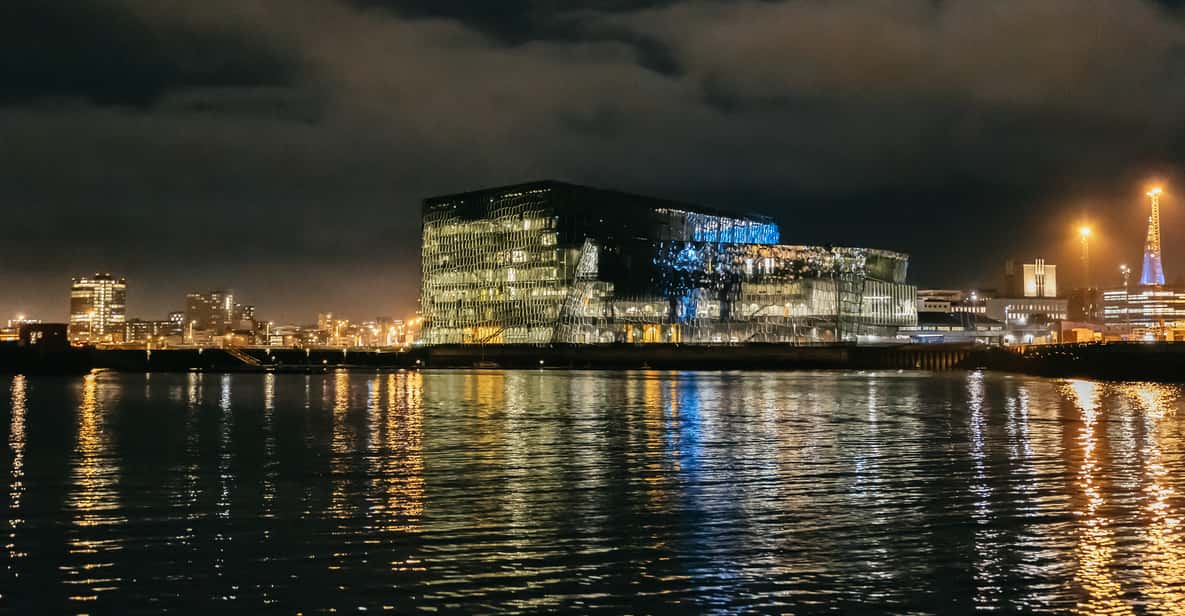
Sometimes. On clear nights with strong activity, the northern lights can appear right above downtown Reykjavik, the harbor, or the seafront around midnight. The Sun Voyager sculpture and Harpa concert hall are walkable spots where moderate to strong displays are visible without a ticket. A cruise gives you the dark waters and full horizon, though.
Cruise on, then chase the lights by land - what to read next
boats sail 4 nautical miles out, dark water in 15 min